Climate change had role in largest extinction in Earth’s history

December 10th, 2018
The collapse of marine species during the Great Dying, the largest extinction in the Earth’s history, is likely to have been caused by global warming.
Up to 96 per cent of all marine species and 70 per cent of terrestrial species were wiped out during the Permian extinction over 250 million years ago.
A new study from the University of Washington and Stanford University indicates that the mass extinction of marine animals was caused by increased marine temperatures and reduced oxygen availability.
As temperatures rose and the metabolism of marine animals sped up, the warmer waters could not hold enough oxygen for them to survive, the report found.
As oceans warm, marine animals’ metabolism speeds up, meaning they require more oxygen, while warmer water holds less oxygen.
Worryingly, the scientists behind the study have warned that “we would be wise to take note” as similar environmental changes are currently underway as a result of climate change.
“These results highlight the future extinction risk arising from a depletion of the ocean’s aerobic capacity that is already underway,” the study concludes.
The tolerance of modern animals to high temperature and low oxygen is believed to be similar to Permian animals as they have evolved under similar environmental conditions, the study found.
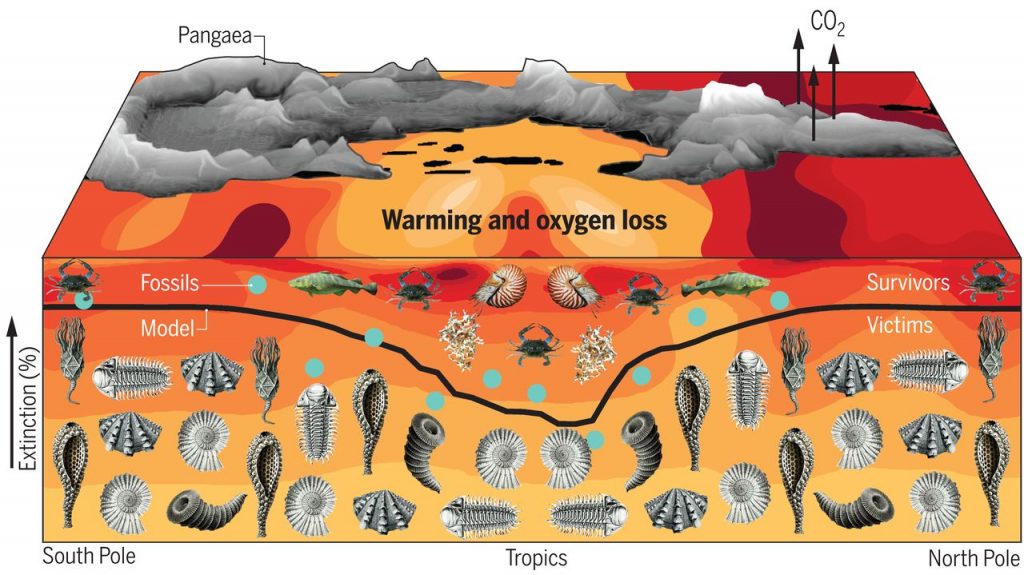
illustration of temperature-dependent hypoxia as a driver of the end-Permian marine mass extinction
Ocean temperatures have continued to rise over the past decade, with 2017 listed as the hottest year in recorded history in a recent study from the Institute of Atmospheric Physics of the Chinese Academy of Sciences.
The past five years have been the warmest for our oceans, the study states, with the rise in temperature largely a result of greenhouse gas emissions from human activities.
According to the University of Washington’s Justin Penn, under a business-as-usual emissions model, warming in the upper ocean by 2100 will be close to 20 per cent of warming levels seen in the late Permian period.
“By the year 2300, it will reach between 35 and 50 per cent [under a business-as-usual model,” Penn warned, thus highlighting the “potential for a mass extinction arising from a similar mechanism under anthropogenic climate change”.
The end of the Permian period for terrestrial plants and animals was brought about as a result of a series of massive volcanic eruptions.
It has remained hotly debated, however, as to how the thriving and diverse marine ecosystem collapsed during this period when the land masses were combined into the Pangaea supercontinent.
The researchers said that other changes, such as acidification or shifts in the productivity of photosynthetic organisms, likely acted as additional causes.
[x_author title=”About the Author”]

Friends of the Earth, An Taisce, and Stop Climate Chaos lead the charge to amend the Climate Bill before it Read more
TV channel ARTE are looking for Irish people to take part in a programme which will air during the COP21 Read more
The Environmental Pillar wishes to make clear to consumers and public that it rejects the awarding of an environmental certificate Read more

The environmental and heritage group are rejecting calls from the Irish Farming Association to shorten the hedge cutting times. An Read more