New bee-friendly roundabout set up in Cork
August 14th, 2018
A new pollinator-friendly roundabout set up in Co Cork aims to support Ireland’s ailing bee population and raise awareness of their plight among the general public.
The Poulavone Roundabout in Ballincollig was recently redesigned into an oasis for bees and other pollinators by Griffins Garden Centre, with the support from the county council and Ballincollig TidyTowns.
Bee-friendly techniques will be used to maintain the roundabout, including the restriction of the use of weedkiller, chemical sprays or other pesticides, one of the biggest threats to bee populations.
According to the EU, almost one-third of bee and butterfly species are declining and one in ten pollinating insects are close to extinction.
The roundabout includes pollinator-friendly plants such as lavender, geranium Rozanne, verbenas and bidens. The roundabout is also decorated with complimentary beehives.
Margaret Griffin, the owner of Griffin Garden Centre, told The Green News that, if finances allow, she would like to see a pollination corridor extended to other parts of Ballincollig.
“The reaction has been huge, people are loving it and it is definitely bringing an awareness of bees,” she said.
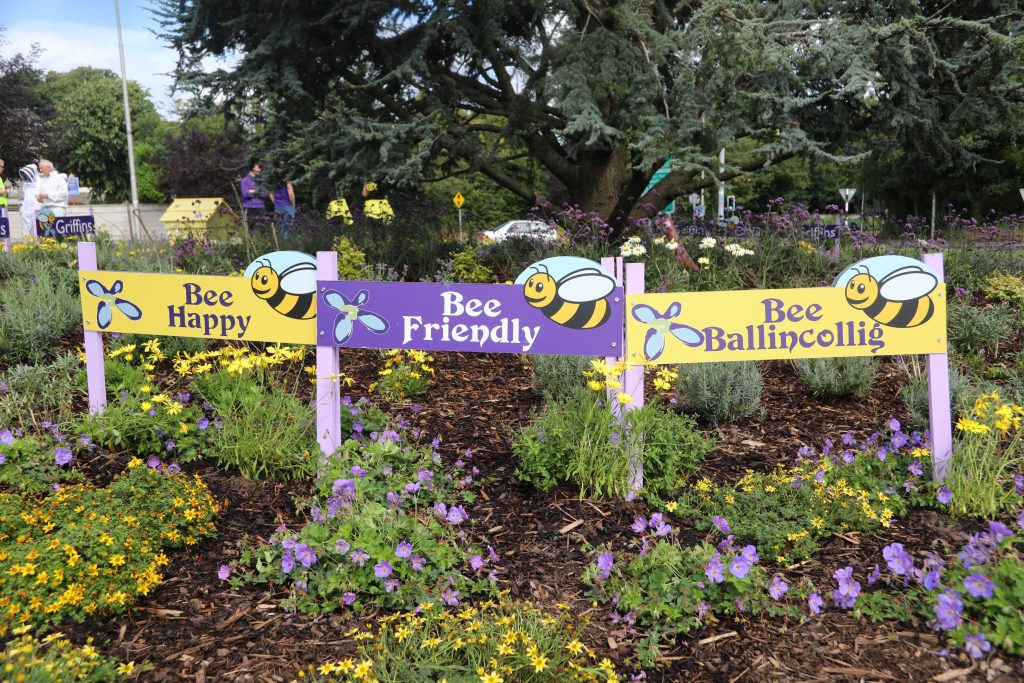
Ireland’s first bee-friendly roundabout in Ballincollig, Co Cork Photo: Timmy Griffin
Earlier this year Kilkenny County Council showed the lead in the adoption of the National Pollinator Plan by putting together an action plan to support the development of pollinator-friendly locations around the county.
With the Garden Bumblebee being nominated as an ambassador of Kilkenny in order to spread awareness, the Plan of Action includes measures such as mapping and signing areas that already support pollinators, as well as working to develop more pollinator-friendly zones.
The All-Ireland Pollinator Plan was set by the group of biologists from the National Biodiversity data Centre encourages people to change their gardening habits into more bee-friendly.
Easy steps such as reducing the use of chemical sprays, mowing grass less or planting more bee-friendly plants can make a huge difference in restoring the population of bees in Ireland, the Plan states.
Dr Una Fitzpatrick, the coordinator of the Plan, warned that the growing tendency in Ireland to tidy up public parks, green spaces and private gardens rather than letting wildflowers grow is having an impact on bees population, cutting out food supplies and shelter.
Earlier this summer, the European Commission proposed new measures in an attempt to halt a decline in wild pollinator populations across Europe.
The Commission’s proposals include improvements in monitoring and data collection and policies to address the social and economic aspects of the decreasing numbers of pollinators.
In the EU alone, four in five crop and wildflower species depend on insect pollination and €15 billion of the bloc’s annual agricultural output is directly attributed to pollination.

20th of June, 2016 Following Brexit a lot of environmentalists have been questioning the effects of leaving the EU. Bees Read more
[cs_content][cs_section parallax="false" style="margin: 0px;padding: 45px 0px;"][cs_row inner_container="true" marginless_columns="false" style="margin: 0px auto;padding: 0px;"][cs_column fade="false" fade_animation="in" fade_animation_offset="45px" fade_duration="750" type="1/1" style="padding: 0px;"][cs_text] October Read more
February 24th 2017 Agrichemical giants, Bayer and Syngenta, are back in the European courts attempting to have the European Commission's Read more

March 3rd 2017 Protesters dressed as bees, foxes and even an Angry Bird, made their presence felt outside the Oireachtas Read more