Long-term global warming trend continues with devastating effect

November 29th, 2018
The long-term warming trend has continued into 2018, with the average global temperature set to be the fourth highest on record, according to the World Meteorological Organization (WMO).
The 20 warmest years on record have been in the past 22 years, according to the WMO provisional Statement on the State of the Climate in 2018. The last four years have been the warmest on record.
The report shows that the global average temperature for the first ten months of the year was nearly 1°C above the pre-industrial baseline.
There is a 75 to 80 per cent chance of a weak El Niño developing by February 2019, the WMO said, meaning that 2019 is likely to be warmer than 2018.
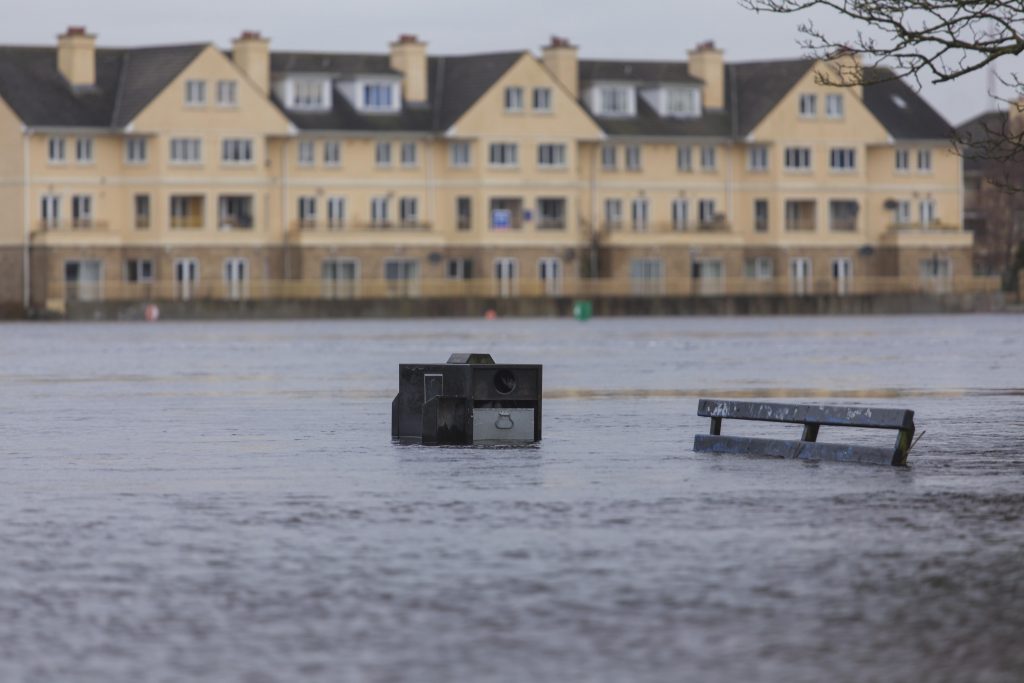
Irish Flooding in 2016 Photo: Niall Sargent
Trail of destruction
Extreme weather has left a “trail of devastation on all continents” this year, the WMO said, with an increase in the number of tropical cyclones, extreme flooding, heatwaves and wildfires.
In August, the southwest Indian state of Kerala suffered the worst flooding since the 1920s, displacing more than 1.4 million people from their homes and affecting more than 5.4 million.
Large parts of western Japan experienced destructive flooding in late June and early July, killing at least 230 people and destroying thousands of homes.
Large parts of Europe experienced exceptional heat and drought during spring and summer, leading to wildfires in Scandinavia, as well as Ireland, Greece, Spain and Portugal.
British Columbia in Canada broke its record for the most area burned in a fire season for the second successive year, while California suffered devastating wildfires, with November’s Camp Fire the deadliest fire in over a century in the US.
‘Not on Track’
According to the WMO’s Secretary-General, Petteri Taalas, we are “not on track” to hit climate targets and “rein in temperature increases”.
With greenhouse gas concentrations at record levels, Mr Taalas said that we may see temperature increases of between three and five degrees Celcius by the end of the century if greater action is not taken now.
“If we exploit all known fossil fuel resources, the temperature rise will be considerably higher,” he warned.
The Intergovernmental Panel on Climate Change (IPCC) special report on Global Warming of 1.5°C released last month warned that we only have 12 years to take concrete action to possibly limit the average global temperature to the 1.5°C threshold.
A new U.S. federal report released last week details how climate change is affecting not just the environment on the continent, but also agriculture, energy, water resources, and human health.
The report indicates that climate change will lead to growing losses to American infrastructure and property and impact the rate of economic growth over this century.
An assessment from the UK’s Met Office out this week warns that the island will see an increased chance of milder, wetter winters and hotter, drier summers along with an increase in the frequency and intensity of extremes.
Summer temperatures could be up to 5.4°C hotter and summer rainfall could decrease by up to 47 per cent by 2070, the report states.
Sea level around the UK will continue to rise to 2100 under all emission pathways, the report states, with sea levels in London potentially up 1.15m by 2100.
[x_author title=”About the Author”]
Devastating winter flooding could be up to eight times more frequent because of climate change, flooding expert has warned.
The Irish government need to stop pleading we are a special case in relation to climate change and start doing Read more
The charity, which works to preserve Ireland’s natural and built heritage, sets out seven key areas that must be acted Read more
Alicia and her Planet Pals visit local schools and teach children about environmental issues using puppet shows and competitions. “We Read more